Saturday, November 21, 2020


Friday, November 20, 2020
On this date in history: November 20


In 1789, New Jersey becomes the first state to ratify the Bill of Rights.
In 1815, the Second Treaty of Paris is agreed upon. After the Battle of Waterloo, France agrees to pay reparations. The Napoleonic Wars end.
In 1815, Russia, Prussia, Austria, and England also sign an alliance “for the maintenance of peace in Europe.
In 1817, the First Seminole War begins in Florida.
In 1861, Kentucky’s Confederate Government files an ordinance of secession.
In 1862, the Confederate Armies of Mississippi and Kentucky merge to create the Army of Tennessee under Braxton Bragg.
In 1910, Revolution, led by Francisco I. Madero, breaks out in Mexico.
In 1917, the first successful use of tanks in warfare occurs. The British use tanks to break the German lines in the battle of Cambrai.
In 1928, Boston Garden opens. The Canadians beat the Bruins 1-0.
In 1940, Hungary, Romania, and Slovakia join the Axis Powers.
In 1942, the British 8th Army recaptures Benghazi, Libya.
In 1943, U-538 is sunk in the Atlantic.
In 1943, US forces land on Tarawa and Makin Atoll in the Gilbert Islands.
In 1945, the Nuremberg War Trials begin. 24 former German leaders are put on trial, most for war crimes related to the Holocaust.
In 1949, the Jewish population of Israel reaches 1 million.
In 1962, Mickey Mantle wins his third AL MVP award.
In 1962, the USSR removes bombers from Cuba. The US lifts the blockade.
In 1966, the Dallas Cowboys sack Pittsburgh quarterbacks an NFL record 12 times in one game.
In 1967, Tom Seaver is named NL Rookie of the Year.
In 1968, the US performs a nuclear weapons test in Nevada.
In 1969, Willie McCovey barely beats Tom Seaver for the NL MVP Award.
In 1971, Richard Petty wins the 21st NASCAR Sprint Cup.
In 1975, Ronald Reagan announces his candidacy for the Republican Presidential nomination.
In 1975, Walter Payton rushes for an NFL record 275 yds in one game.
In 1977, Cale Yarborough wins the 27th NASCAR Sprint Cup.
In 1982, 7-yr-old Drew Barrymore hosts Saturday Night Live.
In 1984, Dwight Gooden wins NL Rookie of the Year.
In 1985, Don Mattingly win the AL MVP Award.
In 1989, Robin Yount wins the AL MVP Award.
In 1990, Rickey Henderson wins the AL MVP Award.
In 1992, Windsor Castle, home of the British Royal Family, catches fire.
In 1995, the “Beatles Anthology, Vol. 1” is released.
In 1995, Princess Diana admits in an interview that she cheated on Prince Charles.
In 1997, Eric Lindros of the Philadelphia Flyers tries to bite Marty McSorley.
In 2016, Jimmie Johnson wins his 7th NASCAR Sprint Cup, equaling Richard Perty and Dale Earnhardt
In 2019, Britain’s Prince Andrew gives in to public outcry over his friendship with Jeffry Epstein, and announces he’s stepping back from public duty.
November 20 is a busy day. There were many more, but this is a brief synopsis.
Thursday, November 19, 2020
Who wants a prize?
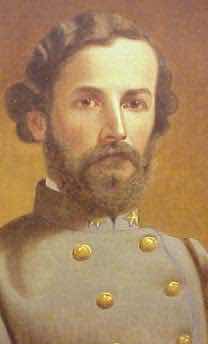
Post the answer in the comments. To give everyone a fair chance, I’ll stop comments at 9:45am CST tomorrow, and will randomly pick a winner from those who posted the correct answer.
Who am I? (The picture is the Civil War ancestor, not the person the post is about).
1. I am named after my grandfather, who was killed in the American Civil War.
2. I learned a lot about horses and warfare from John Singleton Mosby in my early years. He and I often reenacted Civil War battles.
3. I was an Olympian, but lost my chance for gold in my strongest area of competition when the judges said I completely missed the target on a few of my shots. I argued that I didn't miss, but rather that the shots in question passed through holes in the target.
4. I first met my future commander during tank training exercises in Gettysburg.
5. I believed in the tactics of fast mobility, and always hitting hard and being on the offensive.
6. I also believed that an officer's job was not only to ask the impossible of his men, but to get it out of them.
7. I died in a car accident after the war ended in Europe, and I am buried with my men in Luxembourg.
Good luck!
Wednesday, November 18, 2020
Buffalo Soldiers

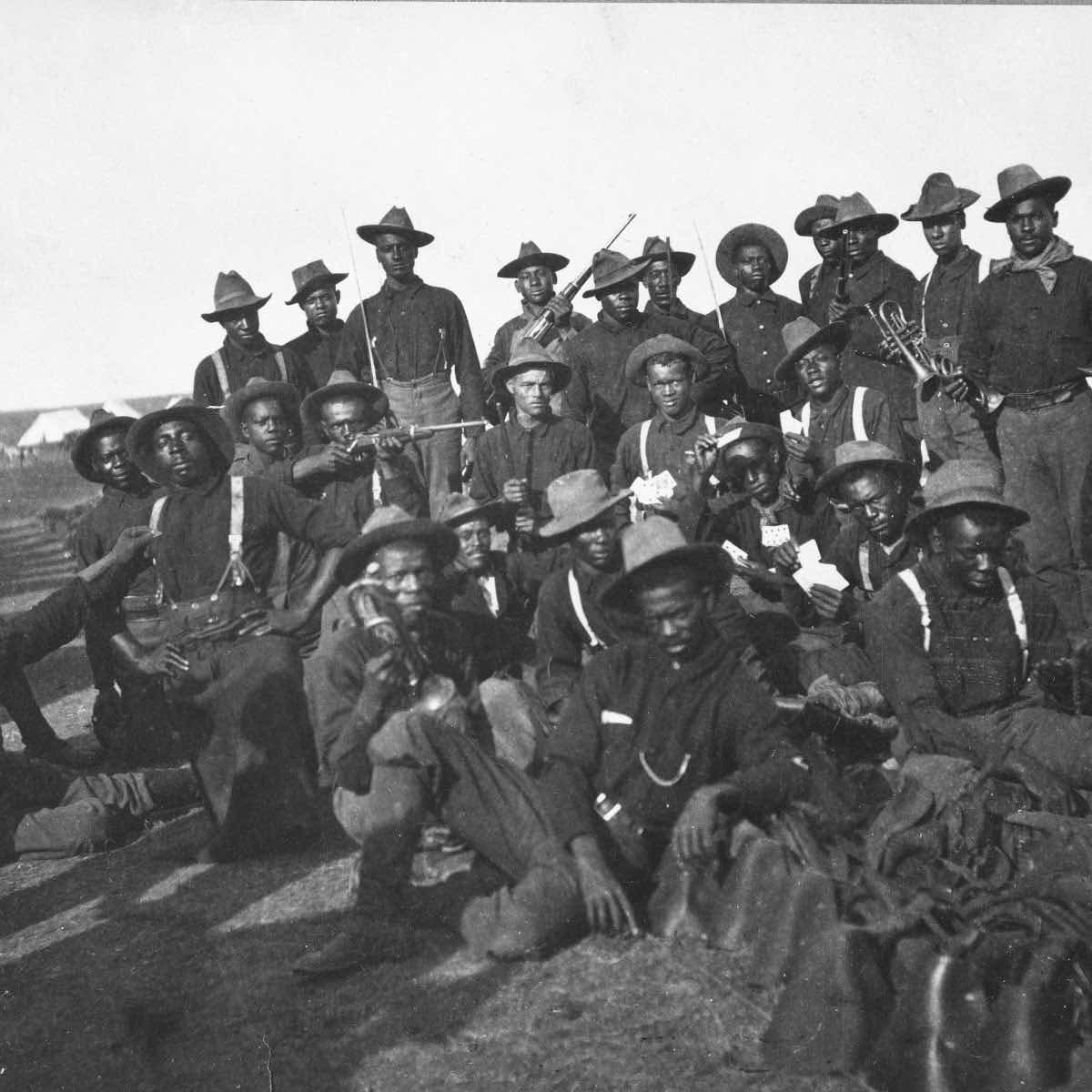

Today’s post comes from a Facebook friend of mine, Allenz Strickland. Allenz tells the story well, so here it goes:
“This post is about the nickname given to African American U.S. Army personnel. For the Bob Marley song.
Buffalo Soldiers originally were members of the 10th Cavalry Regiment of the United States Army, formed on September 21, 1866, at Fort Leavenworth, Kansas. This nickname was given to the Black Cavalry by Native American tribes who fought in the Indian Wars. The term eventually became synonymous with all of the African-American regiments formed in 1866:
9th Cavalry Regiment
10th Cavalry Regiment
24th Infantry Regiment
25th Infantry Regiment
Second 38th Infantry Regiment
Buffalo Soldiers of the 25th Infantry Regiment in 1890
Active:
1866–1951
9th Cavalry Regiment
10th Cavalry Regiment
24th Infantry Regiment
25th Infantry Regiment
Engagements
American Indian Wars
Spanish–American War
Philippine–American War
Mexican Border War
World War I
World War II
Although several African-American regiments were raised during the Civil War as part of the Union Army (including the 54th Massachusetts Volunteer Infantry and the many United States Colored Troops Regiments), the "Buffalo Soldiers" were established by Congress as the first peacetime all-black regiments in the regular U.S. Army] On September 6, 2005, Mark Matthews, the oldest surviving Buffalo Soldier, died at the age of 111. He was buried at Arlington National Cemetery.
Systemic prejudice:
John J. Pershing
General of the Armies John J. Pershing is a controversial figure regarding the Buffalo Soldiers. He served with the 10th Cavalry Regiment from October 1895 to May 1897, starting as a first lieutenant when he took command of a troop of the 10th in October 1895.
In 1897, Pershing became an instructor at West Point, where he joined the tactical staff. West Point cadets upset over Pershing's disciplinary treatment and high standards took to calling him "(N*) Jack," because he had learned to have full respect for black soldiers while leading them. Later during the Spanish–American War, where Pershing served with the 10th for six months in Cuba, the press softened the term to "Black Jack", which they continued to use in World War I.
At the start of the Spanish–American War, First Lieutenant Pershing was offered a brevet rank and commissioned a major of volunteers on August 26, 1898. He fought with the 10th Cavalry (Buffalo Soldiers) on Kettle and San Juan Hills in Cuba and was cited for gallantry.
During World War I, Pershing was the Commander-in-Chief (C-in-C) of the American Expeditionary Force (AEF) on the Western Front. While earlier a champion of the African-American soldier, at this time he did not defend their full participation on the battlefield, but bowed to the racist policies of President Woodrow Wilson, Secretary of War Newton D. Baker, and the Southern Democratic Party with its "separate but equal" philosophy.
Baker was cognizant of the many problems of domestic and allied political involvement in military decision-making during wartime, and gave Pershing unmatched authority to run his command as he saw fit, but Pershing practiced realpolitik carefully where black participation was concerned, not engaging in issues that might distract or diminish his command. Even so, Pershing allowed American soldiers (African Americans) to be under the command of a foreign power for the first time in American history.
The Punitive Expedition, U.S.–Mexico border, and World War I
World War II
Korean War and integration
Medal of Honor recipients (1866–1918) Edit
Memorial to Medal of Honor recipient Corporal Clinton Greaves, 9th US Cavalry, at Fort Bayard, New Mexico
Sgt. John Harris of the 10th U.S. Cavalry with a Sharps rifle, c. 1868.
This list is of the officers and men who received the Medal of Honor due to service with the original units called "Buffalo Soldiers".
Edward L. Baker, Jr.
Dennis Bell
Thomas Boyne
Benjamin Brown
George Ritter Burnett
Louis H. Carpenter
Powhatan Henry Clarke
John Denny
Pompey Factor
Clinton Greaves
Henry Johnson
George Jordan
Fitz Lee
Isaiah Mays
William McBryar
Adam Paine
Isaac Payne
Thomas Shaw
Emanuel Stance
Freddie Stowers
William H. Thompkins
Augustus Walley
George H. Wanton
John Ward
Moses Williams
William Othello Wilson
Brent Woods
This list is of other notable African Americans who served in the original units as "Buffalo Soldiers" from 1866 to 1918.
John Hanks Alexander
Allen Allensworth
Lewis Broadus
Henry Ossian Flipper
Edward W. Pearson, Sr.
Charles Young
Cathay Williams
Today is Buffalo Soldiers Day–proclaimed by President George Bush on 24 July of 1992 and celebrated on 28 July annually thereafter to celebrate the all-black Army regiments’ “outstanding legacy of service.” The Buffalo Soldiers, as Bush acknowledged, are a historically important group best remembered for fighting on American’s western frontier. But “their achievements were not limited to the western United States,” Bush said: Members of the Buffalo Soldiers served in other parts of America and “in places as far-flung as Cuba, Mexico, and the Philippines.” The Buffalo Soldiers fought through both world wars and a number of other conflicts. Throughout all of this, as Bush acknowledged, because of racism “they often received the worst food and equipment and labored without the respect and recognition that were their due.”
There is a great deal more to know about these extraordinary Soldiers as individuals, see my future post that will include more detailed dedications to these individual Soldiers that were essential in the shaping of our Great Nation, ‘Enjoy your Saturday morning Cup of Joe.’”
Saturday, November 14, 2020
Assassination

JFK won the election of 1960. After his inauguration, he appointed his brother Robert F. Kennedy (Bobby) as Attorney General. Bobby was tough, and he vowed to go hard after all elements of organized crime in the US, including the Mafia.
This didn’t actually sit well with their father Joe. Joe Sr. had great political power during the FDR Administration. He also made many contacts with organized crime bosses, most notably Sam Giancana, Santo Trafficante Jr, and Carlos Marcello. Giancana was the boss of the Chicago Outfit, one of the most powerful and influential Mafia organizations of the time.
It has been speculated by many, but never actually proven that Sam Giancana made a deal with Joe Kennedy to get the Chicago dock workers and labor unions to support JFK in the election. Joe is also said to have worked similar deals with people like Trafficante and Marcello. The deal with Giancana, brokered by Frank Sinatra came with a promise; Giancana and the other Mafia bosses would push their people into voting for Jack, and as a result, the Kennedy Administration would basically give the Mafia a free pass to do as they please. It was basically a, “Vote for my son, and I promise that my son will leave you alone!” type of deal.
However, Jack and Bobby didn’t see it that way. Bobby, as Attorney General, started an organized crime task force, and was going after any and all organized crime syndicates. While Joe made the deal that said that organized crime would be left alone, Jack and Bobby were doing all they could to bring down organized crime syndicates.
As you can expect, this didn’t go over well with people like Trafficante and Giancana. They began to feel that Joe Kennedy was using his son to go after and eliminate all rivals and anyone to whom he owed favors. Instead of having a free reign in which to operate, Mafia bosses were being taken down at near record pace. Bobby’s task force was both ruthless and highly successful in its war on organized crime, and the mob bosses planned to retaliate.
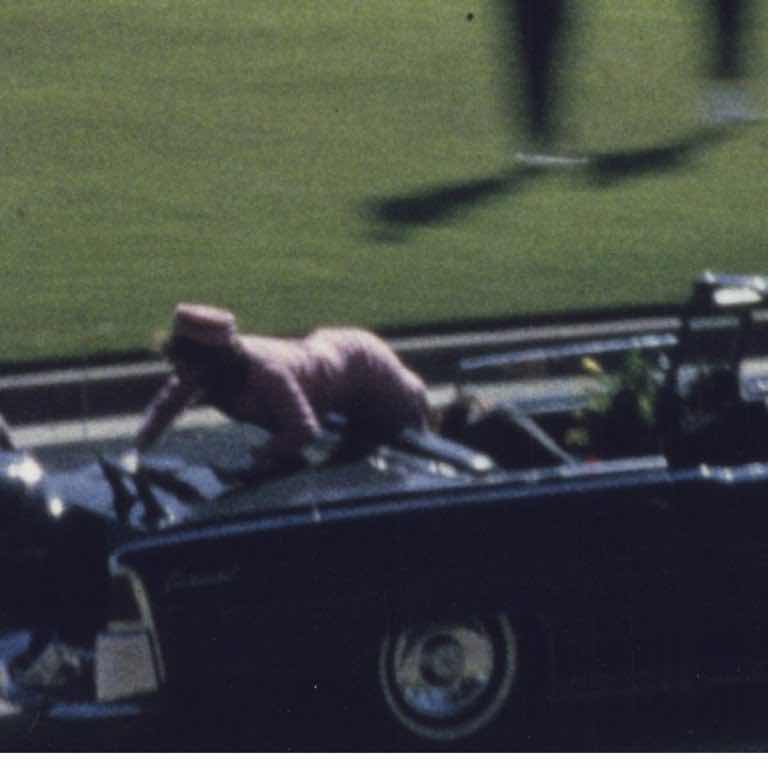
At 12:30pm local time on the morning of November 22, 1963, Lee Harvey Oswald fired on the Kennedy motorcade from a grassy knoll near a book depository in Dallas, TX. Kennedy was in a car with his wife Jackie, Texas Governor John Connally, and Connally’s wife Nellie when Oswald opened fire.
As they were driving through Dealy Plaza, Nellie Connaly turned to JFK and said, “Mr. President, you can’t say Dallas doesn’t love you.”
“No, you can’t!” was The President’s reply.
They were the final words he ever spoke. Shots rang out from the grassy knoll. Kennedy was hit. The same shot that hit the President also hit and severely wounded Governor Connally. A second shot hit the President in the back of his head, and was devastating. Pieces of his skull and brains, and a great deal of blood covered the back seat of the limo.
First Lady Jacqueline started to climb out the back of the limo, though she later said she had no recollection of ever doing so. After she was back in her seat, Jackie turned to the Connally’s and said, “They have killed my husband. I have pieces of his brain in my hand.”
The motorcade quickly sped to nearby Parkland Memorial Hospital. The President was pronounced dead on arrival, nearly thirty minutes after the first shot was fired.
Wednesday, November 11, 2020
The Great War
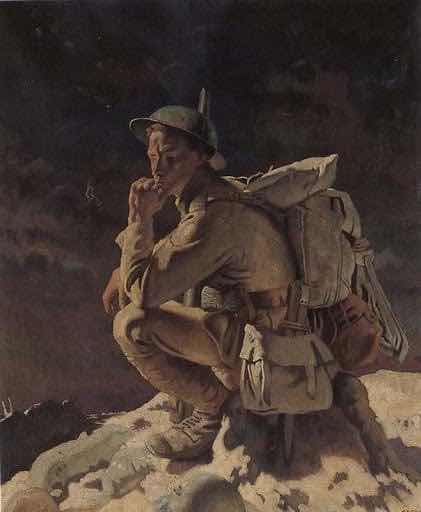
This is a well written piece by my good friend, Paul Driscoll. It is being shared with his permission. Paul also chose the picture.
“The end of the Great War is largely ignored here in the US, and isn't recognized as a Federal holiday like Memorial Day is in May. It's quite the different attitude in Europe and other parts in the world, where the Great War forever changed the landscapes which are now permanantly scarred with the shell holes and trench lines of over 100 years ago. Unexploded munititions continue to pose a threat in places like France and Belgium, and geopolitically we still live in a world bearing the rotten fruit of the consequences of that war. Nowadays I don't think we do much reflecting on the impact of the Great War and how we live in as much a post-WW1 world as we do a post-WW2 one.
Personally I'm always inspired by how veterans of the Great War chose to remember it and how the war influenced entire artistic movements in its wake. The Dada and subsequent Surrealist art movements attempted to convey the horror of that war and the existentialist philosophies that stemmed from it and continued to blossom after the Second World War. Some of the greatest anti-war novels of our time were penned in the 1920's and 1930's by veterans such as Remarque and Chevallier. The earliest post-apocalyptic writings also came out of the Great War, as some veterans saw mankind's potential to annihilate itself completely, while other veterans like J.R.R. Tolkien applied their observations and experiences to create fantasy realms who were equally gripped in the throws of total war. The then-burgeoning field of psychology was heavily influenced by the influx of combat veterans suffering from physiological problems caused by "shell shock," and others who were perpetually haunted by nightmares and hallucinations stemming from their traumatic combat experiences.
And today just as then, we haven't learned any of the lessons of that war. It never was "The War to End All Wars," in fact quite the opposite. The Great War has been the catalyst for many other small and larger conflicts throughout the 20th century and into the 21st. We will always have the scars of the war, and sadly we might continuously be making the mistakes we made back in 1914.
Lest We Forget.”
On the 11th Hour of the 11th Day of the 11th Month...


...the Armistice took effect. The Great War was over. The Allies were victorious, and the World would once again be at peace. In Europe, foes came together and shared cigarettes, stories, comradeship, and wine. The people rejoiced.
In the US, this day would be celebrated as a national holiday. Armistice Day, as it was called was recognized a year later by President Woodrow Wilson, who wrote a message that said,
ADDRESS TO FELLOW-COUNTRYMEN
The White House, November 11, 1919.
A year ago today our enemies laid down their arms in accordance with an armistice which rendered them impotent to renew hostilities, and gave to the world an assured opportunity to reconstruct its shattered order and to work out in peace a new and juster set of international relations. The soldiers and people of the European Allies had fought and endured for more than four years to uphold the barrier of civilization against the aggressions of armed force. We ourselves had been in the conflict something more than a year and a half.
With splendid forgetfulness of mere personal concerns, we remodeled our industries, concentrated our financial resources, increased our agricultural output, and assembled a great army, so that at the last our power was a decisive factor in the victory. We were able to bring the vast resources, material and moral, of a great and free people to the assistance of our associates in Europe who had suffered and sacrificed without limit in the cause for which we fought.
Out of this victory there arose new possibilities of political freedom and economic concert. The war showed us the strength of great nations acting together for high purposes, and the victory of arms foretells the enduring conquests which can be made in peace when nations act justly and in furtherance of the common interests of men.
To us in America the reflections of Armistice Day will be filled with solemn pride in the heroism of those who died in the country's service, and with gratitude for the victory, both because of the thing from which it has freed us and because of the opportunity it has given America to show her sympathy with peace and justice in the councils of nations.
WOODROW WILSON.
The Tradition was established. Armistice Day would be celebrated annually until 1947.
In 1945, WWII veteran Raymond Weeks had the idea to expand the holiday to celebrate all veterans from all wars. Weeks formed a delegation and presented his idea to General Eisenhower. Ike was in favor of a National Veterans Day.
Weeks led the first national celebration in 1947, and did so every year until he died in 1985. Elizabeth Dole declared that Weeks was “the Father of Veterans Day.”
A bill establishing Veterans Day as a national holiday passed in Congress. On May 26, 1954 now President Dwight Eisenhower signed the bill into law. Veterans Day was now officially recognized as a national holiday. Congress amended the bill on June 1, replaced the word “Armistice” with “Veterans”, and officially created the day that we now celebrate as Veterans Day.
At various times and for various reasons, the day of the actual Veterans Day observance was changed, but in 1978 it was officially changed back to November 11. It has remained on that day ever since.
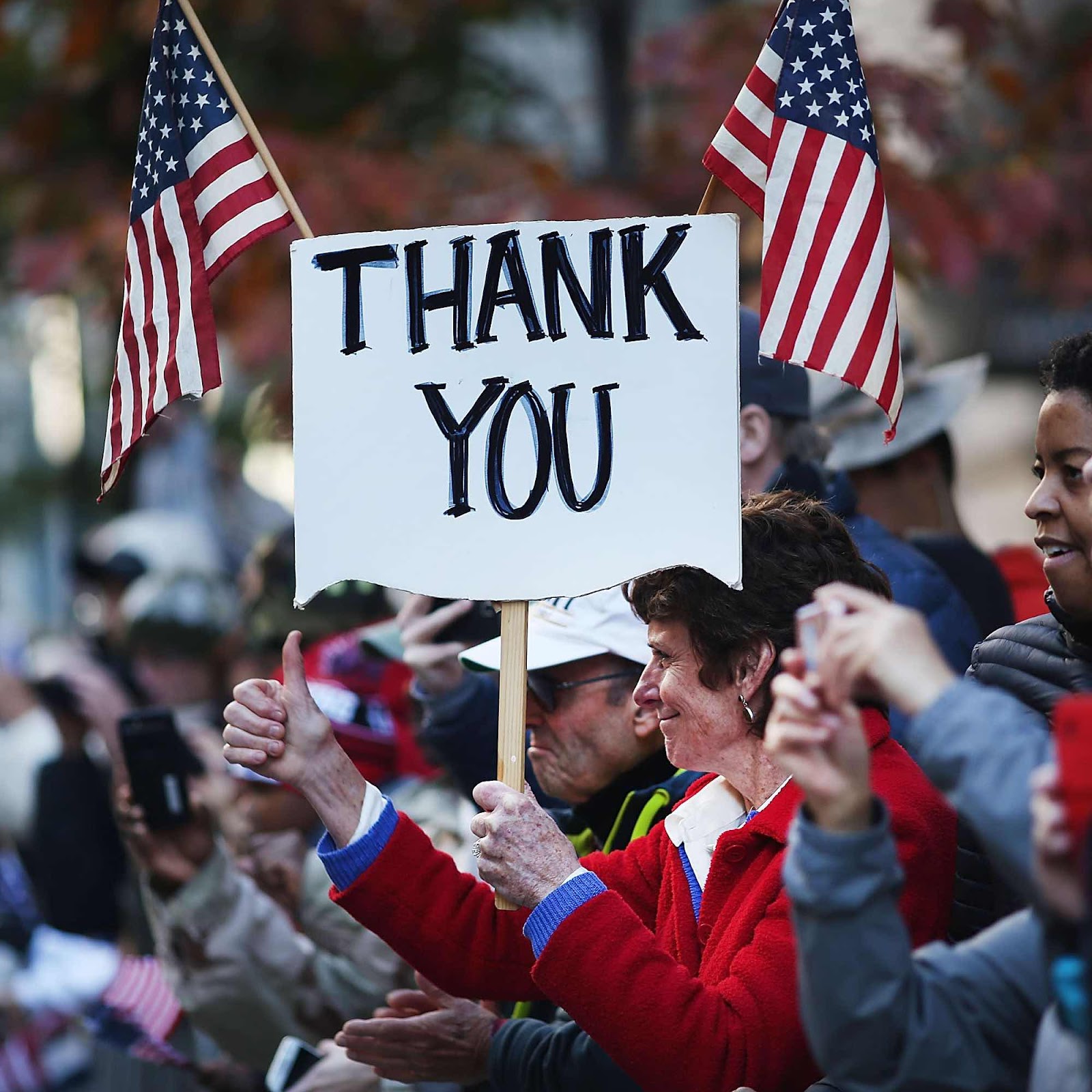
If you see a veteran, thank him or her for their service. We couldn’t be who we are today if they weren’t who they were when called to serve.
To Mike Nugent, Mike Conklin, Kayla Kreeger, Bob Klokis, Nick “Gunny Pop” Popaditch, CJ Brucker, Shawn Brucker, Rob Field, Chad Sokol, Chuck Van Voorhis II, Dale Dye, Ken Dickson, Little Chad Sokol, Laura Garver, Patrick Gorman, and every other veteran I know, I say thank you! God bless you!
Subscribe to:
Posts (Atom)